

WechselrichterDirect medium-voltage inverter THYFREC VT730S / VT732P
A direct medium-voltage inverter that enables variable-speed control of medium-voltage motors.
-

- Auto tuning
- Its auto tuning function makes the task-free on roublesome motor constants setting. It can make the best tuning even to the other supplier's existing motors.
-

- High efficiency operation
- During the light load operation, the motor automatically lowers the output voltage and suppressesthe no-load loss of motor. In so doing, it improves the overall energy efficiency.
-

- Operating ratio setting
- It is a computing function on the gain and bias against against the frequency setting value. It is applied when multiple motors are operated with a different speed in the production line.
-

- Frequency jump
- It can operate the motor avoiding the mechanical resonance point of the motor at the specified frequency. It is effective during the V/f control.
-

- Drooping setting
- The load can be balanced when multiple motors that are mechanically linked are operated. It becomes effective in the vector control and PM motor control modes.
-

- Simple ASR function
- Simple speed control can be performed by installing the speed detection option even when the V/f control mode is selected. High accuracy speed control is possible with simple adjustment.
-

- S-shaped cushion
- Speed changes can be made smooth to alleviate the sharp impact at acceleration and stopping.
-

- Instantaneous restarting
- Even the inverter operation stops during the power outage, its instantaneous stopping and restarting function can search the free-runninng motor rotation frequency after power recovery and match the output frequency and the voltage. In so doing, it can automatically restart the operation.
-

- DC braking
- By applying the DC power to the motor to produce the energy, braking force can be obtained by dissipating the produced energy as heat.
-

- Synchronous changeover to commercial power
- The power of the operating motor can be switched from an off-grid inverter to a grid power or from a grid power to an off-grid inverter in a shock-less manner.
-

- Power regeneration
- Regenerative energy recovered during motor deceleration can be reused for energy-saving operations.
Product Features
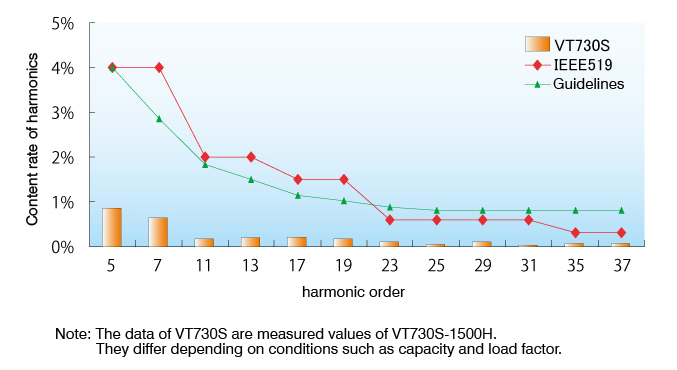

Power-supply harmonics are significantly reduced through multi-phase rectification while maintaining high efficiency and a high power factor.
A single inverter unit complies with Japan’s Ministry of Economy, Trade and Industry (METI) guidelines on harmonics.
In addition, a proprietary PWM method suppresses surge voltage, allowing existing standard motors already in service to be operated safely.
Vector control with an optional speed sensor enables powerful and stable operation that is not affected by load fluctuations.
The regenerative model reuses regenerative energy during deceleration, enabling energy-efficient operation. It is ideal for applications with frequent acceleration and deceleration or extended regenerative operation.
- High efficiency and high power factor
- Reduction of power-supply harmonics
- Surge-voltage suppression
- Powerful and smooth operation
- The standard specifications comply with IEC standards and EMC directives.
- The standard 6 kV series provides performance equivalent to 36-phase rectification.
- A regenerative model is also available.
Applications and Solutions
Fan / blower
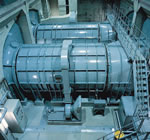
Energy saving
Replacing damper control with inverter-based speed control for dust-collecting blowers, exhaust fans, boiler forced-draft fans, and similar equipment can achieve substantial energy savings.
Further energy savings can be achieved by controlling airflow in air-conditioning systems, gas supply systems, and other factory systems according to seasonal changes and production load variations.
Automation
It enables automatic control of airflow and pressure in boiler forced-draft fans, gas supply systems, and similar equipment according to operating conditions and demand.
Low-noise operation
Low-noise operation can be achieved by reducing the speed of motors used in equipment such as transformer cooling fans and gas supply blowers installed in urban areas. This is particularly effective when power demand decreases during the night or in certain seasons.
Pump
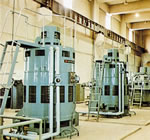
Energy saving
Replacing discharge-valve flow control with inverter-based speed control can achieve substantial energy savings in pump applications.
Energy savings can also be achieved by controlling the flow rate of submersible pumps, cooling-water pumps, and similar equipment according to seasonal changes and demand fluctuations.
Automation
Automatic control can be achieved by adjusting the flow of cooling-water pumps, factory water-supply pumps, and similar equipment according to seasonal changes and demand fluctuations.
Conveyor
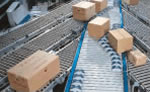
Improving efficiency and performance
By adjusting conveyor speed according to the type of material being conveyed, dust generation can be reduced while improving operating efficiency. Conveyor throughput can be controlled by varying the conveyor speed, and the blending ratio of raw materials can also be controlled by adjusting the feed rate.
Automation and streamlining
It enables automatic adjustment of conveying speed and throughput according to the type of material being conveyed. It also allows fine adjustment of acceleration and deceleration time to help prevent load collapse during conveying.
Extruder
Automation and optimization
It enables automatic adjustment of extrusion rate and extrusion pressure according to the material being processed.
Crane
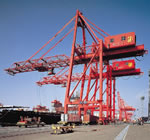
Improving performance
It helps prevent load collapse through cushioned starting and stopping. In addition, the operating speed can be freely set over a wide range, from very low speed to high speed.
Specifications
Product configurations tailored to customer needs


The VT730S and VT732P are available as complete control-panel units, enabling high-quality motor control simply by connecting the unit to the motor.
The cell unit, main controller unit, ground-fault detection unit, and other key components are also available as a kit, enabling optimization for specific applications and flexible panel design.
We offer either complete panel units or individual components, depending on project requirements.
Capacity Table
| VT730S | VT732P | |
|---|---|---|
| Panel | ||
| Application motor | 235-9,800 kW | 1,300 kW |
| Maximum continuous rated current | 3 kV series: 58 A to 635 A 6 kV series: 39 A to 1,130 A |
6 kV series: up to 145 A |
| Overload capacity | 120 % 1 min, 150 % 1 min | |
| Component | ||
| Application motor | 235-15,100 kW | 1,300 kW |
| Maximum continuous rated current | 3 kV series: 58 A to 635 A 6 kV series: 39 A to 1,130 A 10 kV series: 59 A to 1,130 A |
6 kV series: up to 145 A |
| Overload capacity | 120 % 1 min, 150 % 1 min | |
If the required specification is not shown in the table above, please feel free to contact us using the inquiry form.
Control mode
- V/f (variable-torque) control mode
- This mode is ideal for fan and pump applications with square-torque load characteristics, where the required torque is relatively small in the low-speed range.
- V/f (constant-torque) control mode
- This mode provides constant motor torque over a wide variable-speed range and is suitable for applications such as extruders and conveyors.
- Vector control with a speed sensor
- This mode meets demands for high response, high accuracy, and a wide speed-control range. It is ideal for main-drive applications such as film lines and steel-processing lines.
Quick reference table
This quick reference table shows the voltage classes and motor capacity ranges of each series, allowing you to see our product lineup at a glance.
| Category | Models | Voltage | Output (kw) | |
|---|---|---|---|---|
 |
||||
| Low-voltage motor drive | THYFREC VT800 | 200 V / 400 V Series |
 |
|
| Related products | THYFREC CV240S | 200 V / 400 V Series |
 |
|
| Medium-voltage motor drive | THYFREC VT730S / VT732P | 3,000 V / 6,000 V / 10,000 V Series |
 |
|
- Inquiries about this product