

Meidensha delivers world’s first 154 kV, 200 MVA transformer using palm oil
insulation with ODAF cooling


Meidensha Corporation has developed a 154 kV, 200 MVA transformer featuring an oil-directed, air-forced (ODAF) cooling system*1 that uses eco‑friendly, plant-derived palm fatty acid esters (palm oil*2) as the insulating and cooling medium. According to a Meidensha study, it is the world’s first transformer of this class to adopt palm oil for insulation and cooling.
After completing comprehensive performance tests, the unit was delivered to TEPCO Power Grid, Inc.
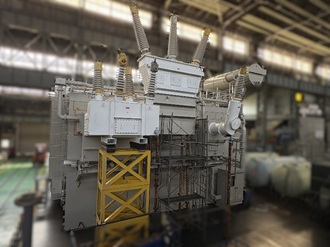
154 kV, 200 MVA transformer with oil-directed, air-forced (ODAF) cooling, using palm-oil insulation.
Meidensha has offered a line-up of transformers, including those using palm oil, rapeseed oil, soybean oil and synthetic esters. This means the company offers all three kinds stipulated in JIS C 2390 of readily biodegradable electrical insulating oils*3: modified esters derived from vegetable oils, natural esters (vegetable oils), and synthetic esters.
Palm oil has mainly been used in relatively small-capacity power distribution transformers. To apply palm oil to this product with an ODAF cooling system, the company conducted measurements and analytical assessments regarding the oil’s streaming electrification properties, in addition to standard tests.
The results allowed Meidensha to apply an ODAF system with a unit cooler to a 154 kV, 200 MVA-class power-transmission transformer for the first time in the world. This will expand the use of ODAF systems in vegetable‑oil transformers, marking a key step toward broader adoption of eco‑friendly products for power infrastructure in Japan and abroad.
Product features
- Low-loss design contributing to decarbonization
- High biodegradability for environmental safety
- Suppression of streaming electrification
- Eco-friendliness with a compact cooling apparatus
Meidensha remains committed to advancing the environmental performance, safety, and reliability of its products, and to providing solutions that contribute to a sustainable society. The company also aims to develop higher‑voltage, larger‑capacity, plant‑derived ester transformers to meet the needs of power infrastructure operators in Japan and abroad.
Press release for reference
June 29, 2023
Meiden expands the lineup of Ester-filled Transformer with the aim of realizing a sustainable society
20230629.pdf
*1: A cooling method for insulating oil that uses an oil transfer pump to circulate the oil through the winding conductors, with a fan used to cool the circulating oil.
*2: Palm oil (fat) can be produced with a high productivity and harvested all year around. Although its production volume is rising year by year, it has led to various problems associated with human rights, labor and the environment. Meiden recognizes the risk that its business activities may impose negative effects on sustainable development. Meiden’s policy is to procure palm fatty acid ester only from procurement partners that support or promote measures to solve these problems.
*3: JIS C 2390: 2019 Readily biodegradable electric insulating oils. JIS C 2390 series are comprised from Part 1: Synthetic ester (JIS C 2390-1: 2019); Part 2: Natural esters (Vegetable oils) (JIS C 2390-2:2019); Part 3: Modified esters derived from vegetable oils (JIS C 2390-3: 2019).
*4: Transformers with a capacity of around 20 MVA, designed to step down high-voltage electricity to levels usable in factories and buildings before the power is supplied.
*5: This phenomenon refers to the generation and accumulation of static electricity caused by charge separation when liquids such as insulating oil or fuel flow inside a pipe and come into contact with the pipe wall or experience friction. The faster the liquid flow and the lower the liquid’s conductivity, the more likely streaming electrification is to occur. This can trigger static electricity fires and damage insulation in hydraulic equipment, transformers, and fuel transport pipelines.